
Salmonidae

SALMONIDAE

Preserving rivers.
Protecting life.

Salmonidae is a non-profit global organization dedicated to the preservation of salmonid species and the rivers they depend on.

The name Salmonidae comes from the Latin scientific classification for the family of fish that includes salmon, trout, char, grayling, huchen, taimen, and other cold-water freshwater species found across the northern hemisphere.

These fish are among the most important indicators of a healthy river system.

Salmonids require cold, clean, oxygen-rich water and intact migration routes to survive. When these species disappear from a river, the effects rarely stop with the fish themselves. It impacts insects, birds, forests, predators, water quality, local communities, and entire ecosystems connected to the river.

In many ways, salmon are nature's warning system.

Protecting salmonids ultimately means protecting rivers. And protecting rivers means protecting far more than water alone.

This is not only an effort to preserve fish species, but to help preserve living river systems — and the cultural, ecological, and historical importance surrounding them.

Many of the rivers that shaped communities and traditions for centuries are under growing pressure from pollution, fragmentation, overdevelopment, warming waters, and loss of biodiversity. At the same time, much of the respect, knowledge, and stewardship once naturally connected to rivers is slowly disappearing as well.

We started Salmonidae because we believe rivers deserve a stronger cultural and ecological presence in the modern world.

Our ambition is not to create another loud environmental campaign, but to build a long-term institution around rivers and salmonid ecosystems — one that brings together conservation, science, storytelling, restoration, education, and cultural preservation under a shared vision.

A place where fishermen, scientists, conservationists, governments, local communities, landowners, artists, and supporters can contribute toward the same goal: ensuring that future generations inherit living rivers, not memories of them.
Our Vision

A world where wild salmonid rivers continue to exist as healthy living ecosystems — protected not only because they are useful, but because they are irreplaceable.

Our Mission

To document, support, restore, and help preserve salmonid rivers and species through awareness, conservation initiatives, partnerships, storytelling, and long-term stewardship.

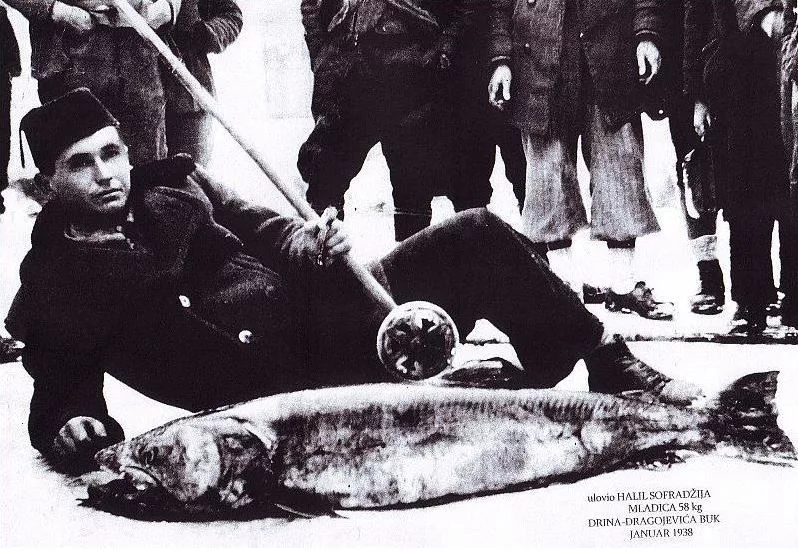
Halil Sofradzija with a Hucho hucho, Drina River, 1938
Halil Sofradzija with one of the largest recorded specimens of Hucho hucho, often referred to as the Danube salmon — Drina, Dragojevića Buk, January 1938.

This initiative is also deeply personal to us.

Salmonidae was founded by three generations of the Sofradzija family: Adi Sofradzija, his father Menso Sofradzija, and his uncle, Dr. Professor Emeritus Avdo Sofradzija.

Our family grew up around the Drina River, part of the Danube watershed — a river system that has shaped life, culture, and communities across the Balkans for centuries.

Fly fishing and river life have been passed down through generations in our family. Time spent on the river was never only about catching fish, but about patience, observation, respect for nature, and understanding the rhythms of water and seasons.

In 1938, our great-grandfather Halil Sofradzija caught one of the largest recorded specimens of Hucho hucho, often referred to as the Danube salmon. Fishermen, generals, politicians, and visitors traveled to the small town of Ustikolina because of the river and the extraordinary fish that lived within it.

Dr. Avdo Sofradzija later dedicated much of his life to biology and freshwater species, becoming Professor Emeritus at the University of Sarajevo and publishing scientific work on freshwater ecosystems and fish species of the region.

Across generations, rivers remained a constant part of our family's life — shaping how we think about nature, stewardship, patience, and responsibility.

Salmonidae was born from that perspective: a belief that rivers are among the most important living systems we still have, and that protecting them requires both practical conservation and cultural continuity.

We are starting simply.

With rivers.
With stories.
And with the species that still return upstream.

Adi Sofradzija signatureAdi SofradzijaFounder
Menso Sofradzija signatureMenso SofradzijaFounder
Dr. Avdo Sofradzija signatureDr. Avdo SofradzijaFounder / Professor Emeritus